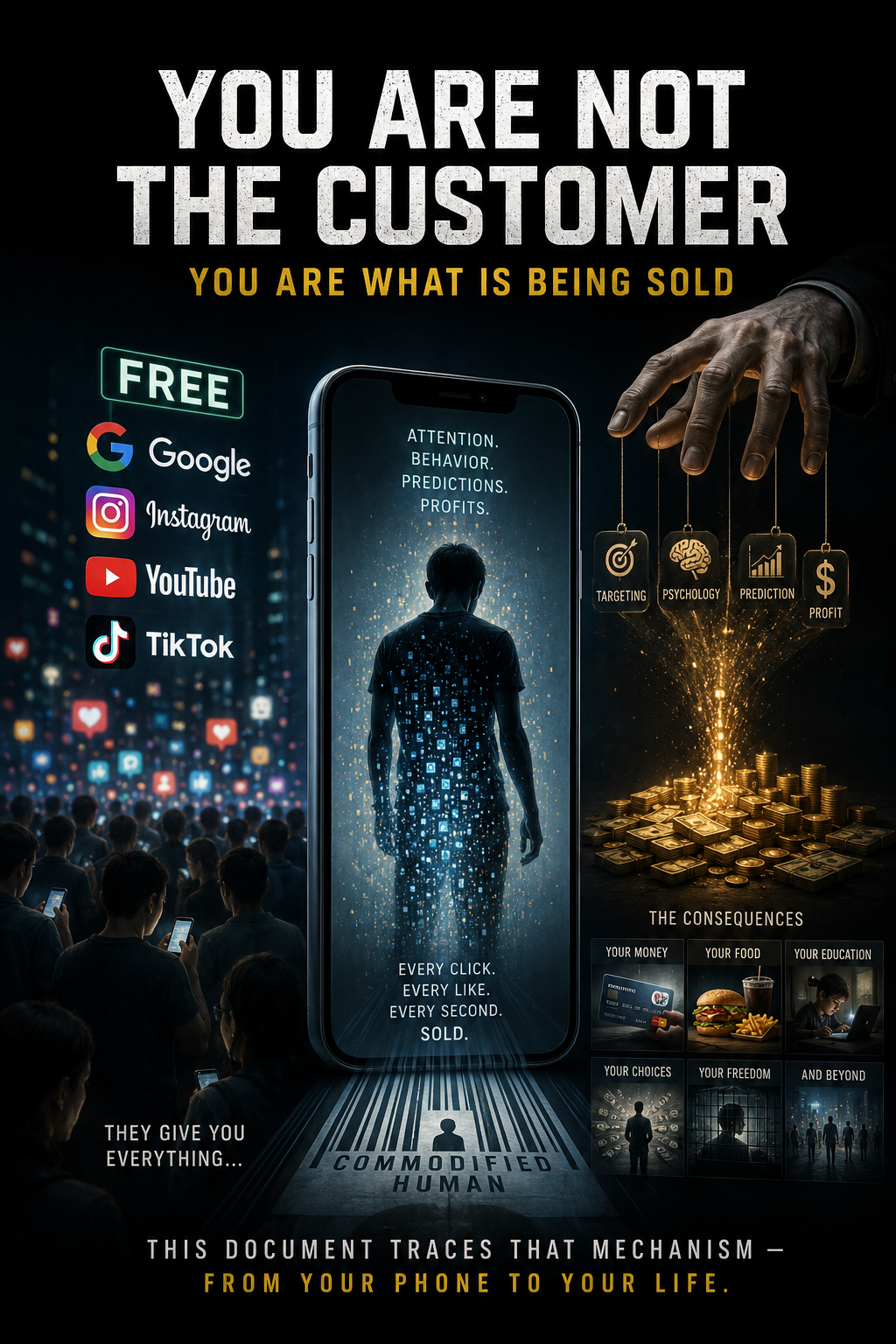
Because Every Service Is Free. You are what is being sold.
Who Holds Your Scale?
You wake up. You reach for your phone. Before your feet touch the floor, you have already checked your email, scrolled through Instagram, glanced at the news, and opened a messaging app.
All free.
You drive to work using Google Maps. Free. You listen to a podcast on a platform that charges you nothing. You search for something at lunch — free. Your teenager watches four hours of YouTube after school — free. Your family shares photos, coordinates schedules, keeps in touch with relatives across three time zones — all free.
Now ask one question.
How is the company providing these free services worth two trillion dollars?
Think about it the way you would think about any other business. A bakery gives away free bread every morning. No charge. Come in, take what you want, enjoy. How long does that bakery survive? A week? A month? It goes bankrupt — because a business that gives its product away for free and charges nothing has no revenue.
Google gives its product away for free and is worth two trillion dollars. Meta gives its product away for free and is worth one and a half trillion. TikTok's parent company gives its product away for free and is valued at over two hundred billion.
Something does not add up. Unless you are not the customer.
You are not the customer. You are the product.
Google does not sell you search. It sells your search history to advertisers. Instagram does not give you a feed. It sells your attention, your habits, and your social graph to brands. YouTube does not give you videos. It sells your watch patterns, your preferences, and your emotional responses to the highest bidder. TikTok does not give you entertainment. It builds a behavioural profile so precise it can predict what you will click before you know you want to.
The bakery analogy was wrong — but not in the way you think. The bakery is not giving away bread. The bakery is giving away the oven — and you are the bread.
That is not the problem. That is the receipt. The problem is much wider than your phone.
There is a word for this kind of power structure. Democracy is rule by the people. Plutocracy is rule by wealth. Metrocracy — from the Greek metron (measure) and kratia (power) — is rule by measurement. Whoever controls how value is measured holds the real power, regardless of what anyone else does.
Your phone is the most visible example. But the same mechanism — the party that controls the Measure captures the value — operates across every domain of your life. Your products. Your money. Your environment. Your food. Your education. Your sense of what is natural and what is possible.
This document is an audit of that mechanism. Not a political argument. Not a conspiracy theory. A walk through the evidence, domain by domain. Each section names a specific Measure that was captured and the specific party that captured it.
By the end, one pattern will be clear: you have been measured your entire life — by parties that profit from the measurement. The scale was never yours.
1. Your Products
You bought a phone. It worked well. Fast, responsive, reliable.
Then a software update arrived. You installed it — because the phone told you to. After the update, the phone was slower. Apps took longer to open. The battery drained faster. Within a few months, you were in the shop looking at the new model.
This is not an accident. Apple deliberately throttled older iPhones through software updates — confirmed in court, settled for $113 million in 2020. The phone worked fine. The software made it slow. The slowness made you buy a new one.
Apple controlled the Measure of performance. And they adjusted it downward to produce a purchase.
The pattern is older than smartphones. In 1924, the world's largest light bulb manufacturers formed the Phoebus cartel and agreed — in writing — to reduce bulb lifespan from 2,500 hours to 1,000 hours. The technology for longer-lasting bulbs existed. The manufacturers chose to shorten it. The Measure of "adequate product life" was set by the party that profits from replacement.
Your printer tells you the ink is low when the cartridge still contains 40–60% of its ink. The Measure of "empty" was set by the party that sells refills.
The fashion industry produces 92 million tonnes of textile waste per year. Nothing is physically wrong with last season's clothes. The Measure of "acceptable appearance" was moved by the party that profits from the movement. You did not decide your wardrobe was outdated. A calendar decided — and the calendar belongs to them.
In every case: the product could last longer. The Measure was moved to produce the purchase. The party that controls the Measure of "good enough" controls when you buy again.
2. Your Money
Here is a question nobody asked you to vote on: why is success measured in money?
Not in contribution. Not in knowledge. Not in craft. Not in how well you raised your children or held your community together. In money. Net worth. The number in the account.
This is not a natural law. It is an authored Measure. And it serves the party that controls the financial system — because if success is defined as money, then every human goal runs through their infrastructure. Every ambition ends up as a transaction they process, a loan they issue, or a fee they collect.
A teacher who shapes a thousand minds is "less successful" than a trader who shapes a spreadsheet. A parent who raises children well is "not working." A craftsman who makes things that last is "less efficient" than one who makes things that break. A community that shares resources is "less productive" than one where everyone buys individually.
And underneath the success Measure sits an even deeper one. When a commercial bank issues a loan, it creates the principal — the amount you borrow. The interest is not created. It does not exist anywhere in the system at the moment the loan is signed. Which means there are always more debt obligations in existence than money to meet them. Always. By design.
Your lifetime of work pays interest to a party that created the obligation out of nothing. The Measure of value is debt. And the debt can never be fully repaid — because the system was designed that way.
Nobody asked you whether success should be measured in dollars. That decision was made before you were born — by the party that issues the dollars.
3. Your Environment
You have been told to fly less. Recycle more. Use paper straws. Calculate your carbon footprint. Eat less meat. Turn off the lights.
Here are some numbers.
One hundred companies produce 71% of all global greenhouse gas emissions (Carbon Majors Report, 2017). The "personal carbon footprint" — the concept that you are responsible for tracking your individual emissions — was invented by BP's advertising agency in 2004. Not by scientists. By a fossil fuel company's marketing team. The purpose was to shift the Measure of environmental responsibility from the producer to the consumer.
Private jets emit 40 times more carbon per passenger than commercial flights. The people telling you to fly less are flying more — in planes that produce forty times the damage per seat.
Planned obsolescence (Section 1) generates 50 million tonnes of electronic waste per year. Manufacturers design products to break. Then you are told to "responsibly recycle" the waste they engineered.
The Measure of environmental responsibility was moved from the party that produces the pollution to the party that consumes the product. You get a carbon calculator. They get a private jet.
You are being measured on your recycling. They are not being measured on their production. Same architecture as the football pitch: you run harder on your end; the goals are on their end.
4. Your Food and Health
Who decides what "healthy" means?
In the 1960s, the sugar industry paid Harvard researchers to publish studies that shifted the blame for heart disease from sugar to dietary fat. The papers were published in the New England Journal of Medicine. The funding was not disclosed. Dietary guidelines for the next forty years were shaped by research paid for by the industry that benefited from the conclusion.
The United States Department of Agriculture simultaneously promotes the agriculture industry and sets the national dietary guidelines. The party that profits from food production is the same party that tells you what to eat. The vendor is the auditor.
In 2017, the American College of Cardiology lowered the threshold for "high blood pressure" from 140/90 to 130/80. Overnight, 31 million Americans who were healthy the day before became patients who "needed treatment." The Measure of "sick" was adjusted by a body with financial ties to the pharmaceutical industry that sells the treatment.
The party that sells the treatment decides what counts as illness. The party that sells the food decides what counts as nutrition. Same architecture. Different building.
5. Your Education
You were told that a degree would open doors. You studied. You graduated. You entered the workforce carrying $30,000, $50,000, $100,000 in debt.
Total student debt in the United States: $1.77 trillion. The Measure of "qualified" was set by the party that sells the credential. The university decides what counts as educated. The university profits from the decision. The vendor is the auditor.
And the content of the education itself: notice what is absent. Financial literacy — understanding how money, debt, and interest actually work — is not in most curricula. Critical thinking — the skill of evaluating whether a system is designed in your interest — is taught in fragments if at all. Cooperative economics — the study of how people can coordinate to produce value without intermediaries capturing it — is not a standard subject anywhere.
These absences are not accidental. The Measure of "educated" was set by the party that benefits from a particular kind of workforce: specialised enough to be productive, compliant enough to carry the debt, and uninformed enough not to question the architecture.
6. Your Competition
You were taught that competition is natural. That the strong survive. That winners and losers are the inevitable output of any system.
Here is what the evolutionary biology actually says.
Within a group, the selfish beat the cooperative. The hoarder beats the sharer. The defector beats the trusting. Playing for yourself — on the street — wins.
Between groups, the pattern reverses. Every time. A group that cooperates internally destroys a group that competes internally. Ants and bees — two lineages evolved independently — account for roughly a fifth of all animal life on land. Dominant for the same structural reason: internal cooperation.
Both patterns are natural. Both are real. You were taught one of them and not the other.
Why? Because competition between individuals serves the party that operates above the competition. If workers compete with each other for jobs, wages go down. If consumers compete with each other for status, spending goes up. If nations compete with each other for capital, regulations go down.
The people at the top do not compete with each other. They cooperate — quietly, professionally, effectively. They share information, coordinate strategy, and protect each other's positions. They run the other rulebook. The one you were never taught.
The Measure of "natural" was set by the party that benefits from your competition.
7. Your Attention
This is the most sensitive section in this document — and it must be handled with precision, not politics.
Here is the forensic observation: when any population is fragmented into groups that compete with each other for recognition, that population becomes incapable of coordinating on shared economic interests.
This is not new. The mechanism has a name in political history: divide et impera — divide and rule. It works by moving the Measure of injustice.
When injustice is measured by economic class — are you being extracted from? are you working harder and falling further behind? — the answer unites people across every other category. The teacher, the nurse, the tradesperson, the single parent, the freelancer — they share the same structural condition regardless of any other category they belong to.
When injustice is measured by identity categories — are you being recognised? is your group represented? — the answer divides people who share the same economic condition into competing camps. Each group fights for recognition against other groups at the same economic level. The party above the fragmentation is never questioned — because the argument is horizontal, not vertical.
The forensic question is not whether any specific identity is valid. People's identities are real and matter. The forensic question is: who benefits from a population that is fragmented into competing groups and cannot coordinate on shared interest? And the answer is consistent across every historical instance: the party that operates above the fragmentation.
The Measure of injustice was moved from economic interest (which unites) to identity categories (which divide). Both questions are legitimate. But only one of them threatens the architecture that produces the extraction.
The Turn: Your Digital Life
Every domain described above — your products, your money, your environment, your food, your education, your competition, your attention — operates on the same mechanism. The party that controls the Measure captures the value.
But there is one domain where the mechanism is more advanced, more personal, and more complete than anywhere else.
Your digital life.
Google gives you search for free — and sells your search history to advertisers. Instagram gives you a feed for free — and sells your attention, your habits, and your social graph to brands. YouTube gives you videos for free — and sells your watch patterns, your preferences, and your emotional responses to the highest bidder. TikTok gives you entertainment for free — and builds a behavioural profile so precise it can predict what you will click before you know you want to.
None of these companies charge you money. All of them charge you something more valuable: the detailed record of who you are, what you want, and how you can be influenced.
You are not using the platform. The platform is using you.
But digital extraction goes further than data harvesting. These platforms do not just measure your behaviour — they shape it. They decide what you see first thing in the morning. They choose which opinions appear credible and which disappear. They determine which version of the news reaches you. Over time, the algorithm does not just respond to your preferences — it forms them. What you believe is important, what you think is normal, what you consider possible — all filtered through a system designed not to inform you, but to keep you engaged.
The platform is not a mirror reflecting reality. It is a lens bending reality toward whatever keeps you on the screen longest.
And your contributions — the content you create, the knowledge you share, the connections you build, the communities you form — generate the value that makes the platform worth billions. Your hour of creative work becomes their revenue. Your expertise becomes their training data. Your social connections become their network effects. You create. They score.
The most detailed portrait of who you are that has ever existed — assembled from a lifetime of clicks, searches, pauses, connections, and hesitations — belongs to a corporation whose business model is selling access to it. You have never been asked whether this is acceptable. The question was taken off the table before you arrived.
In every other domain in this document, the extraction is indirect. A shorter bulb life, a shifted dietary guideline, a debt you cannot repay. In the digital domain, the extraction is direct, continuous, and intimate. The Measure of your attention, your identity, your contributions, and your worth is controlled entirely by the platform — and you cannot see the formula.
These platforms are not democracies. They are not free markets. They are centralised metrocracies — systems where absolute power is held by the party that controls the measurement of value.
The Pattern
Every section of this document describes the same architecture.
Your products — the Measure of "good enough" set by the party that sells replacements.
Your money — the Measure of success set by the party that issues the currency.
Your environment — the Measure of responsibility moved from producer to consumer, by the producer.
Your food and health — the Measure of "healthy" set by the party that profits from treatment.
Your education — the Measure of "qualified" set by the party that sells the credential.
Your competition — the Measure of "natural" set by the party that benefits from your competition.
Your attention — the Measure of injustice moved from interest to identity, by the party above both.
Your digital life — the Measure of value, attention, and identity captured entirely by the platform.
Every domain. Same mechanism. Centralised metrocracy. Rule by captured Measure. The party that controls how value is measured holds the power. The scale was never yours.
The Engineering Response
The diagnosis is clear. The question is whether the architecture can be different.
Whether the Measure can be distributed rather than captured. Whether the rules can be visible, collectively held, and auditable by everyone. Whether a pitch can be built with goals on both sides — where the people who create the value also hold the Measure that determines what it is worth.
That engineering response exists. It is documented in detail — every component, every mechanism, every protection, every failure mode — in the MarpoleAI whitepaper.
The whitepaper does not diagnose. This document does that. The whitepaper builds. It describes a trust and coordination architecture where:
- The Measure is encoded in smart contracts — visible, auditable, collectively governed
- Reputation is earned through verified contribution and cannot be bought
- Every record is permanent and no party can silently alter it
- The architecture limits itself through constitutional protections that no majority can override
- Every component has been proven at scale in an existing system
The problem is the pitch. The engineering for a different pitch exists.
Read the whitepaper: marpole.ai
You have been measured your entire life — by parties that profit from the measurement. The scale was never yours. The question is whether it can be.