Marpole is the Caliper of Calipers
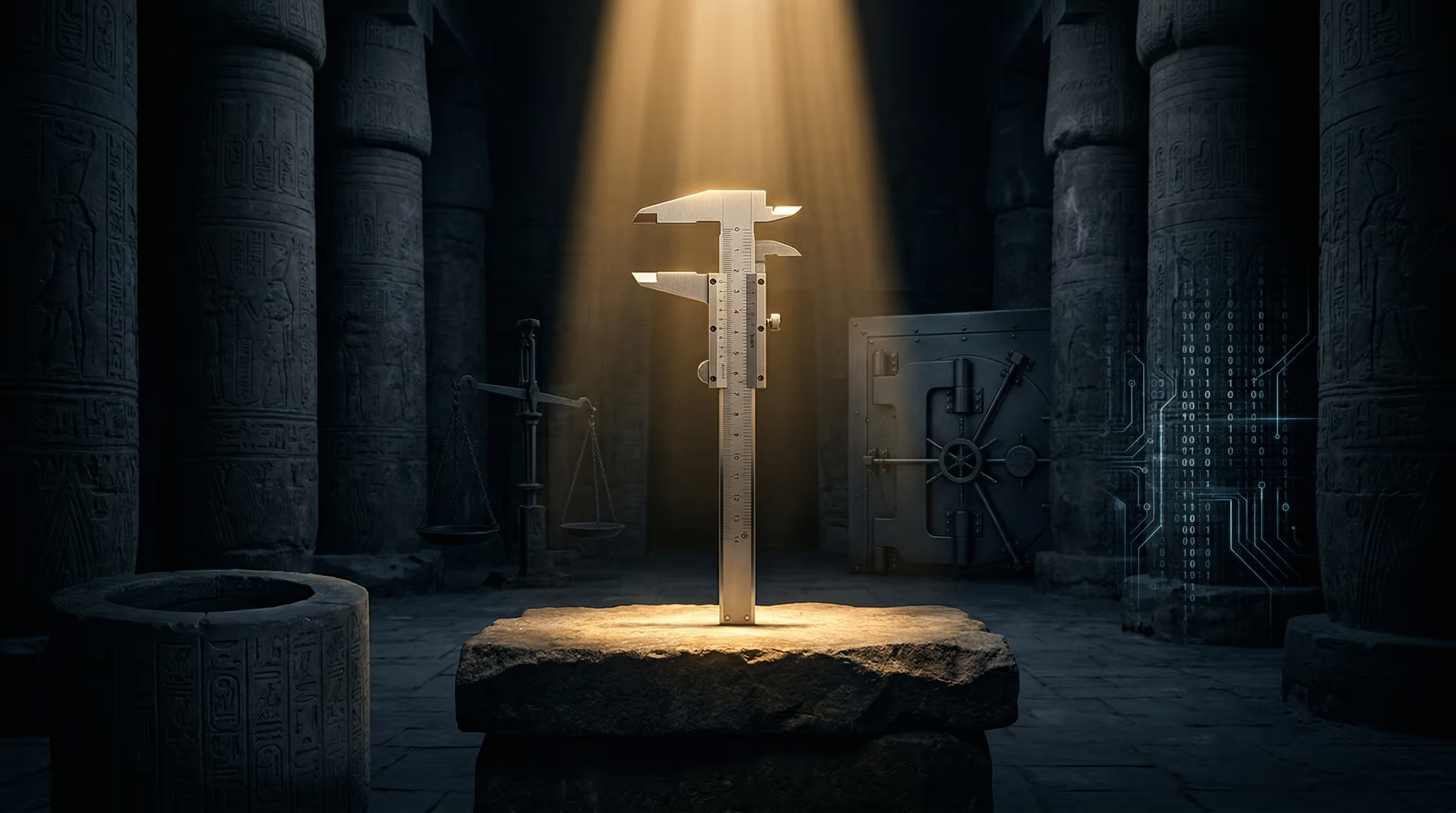
The Caliper of Calipers
On who holds the measure — and why that matters more than who holds the money
Dmitri Maxim, CMA
There is a professional instrument called a vernier caliper.
It measures to the hundredth of a millimetre. Engineers trust it with lives — literally: aircraft components, surgical instruments, load-bearing bridge joints.
But there is a question that any real engineer asks before beginning any measurement:
Is the instrument itself correctly calibrated?
Because if the measuring instrument lies, everything you measure with it lies too. Perfectly. Systematically. Without a single random error.
Every time. In the same direction.
I want to talk about who holds the instrument that measures reality — and what happens when it is calibrated against you.
Five Thousand Years of the Same Scheme

Ancient Egypt. The Nile floods every year — and the water level determines everything: harvest, taxes, the lives of millions of people.
The priests built nilometers — special wells connected to the river, hidden inside temples. Only they knew the real numbers of the coming flood.
They didn't plough. They didn't build. They didn't fight.
They held the measuring instrument.
That was enough to own everything else.
The peasant worked sunrise to sunset. The priest never touched the soil. But the surplus accumulated in the temple. Not because the priest worked harder. Because he knew the numbers the peasant did not.
Replace "Nile flood level" with "news-feed algorithm." Replace "priests of Amun" with "Google data analysts." Replace "nilometer" with "analytics dashboard."
The substance hasn't changed by a single iota.
The Invariant of Power
Eras change. Instruments change. One thing does not.
Whoever controls the measure controls the reality of everyone who uses it.
AgrarianLand & harvestPriests, feudal lords
MercantileGuild standards — cloth, metal, grainGuild masters
FinancialInterest rateBanks
InformationAlgorithmPlatforms
In the mercantile era the measure was the guild standard — the length of a bolt of cloth, the weight of a bar of metal, the grade of grain. The guilds controlled it. The ruler was rubber: when they sold to you it stretched; when they bought from you it shrank. You couldn't verify it. You had no instrument of your own.
In the financial era the measure became the interest rate. The Bank of England spelled it out in plain language in its own 2014 quarterly bulletin: commercial banks create money from nothing at the moment they issue a loan. They create the principal. They do not create the interest. The interest must come from the real economy — from someone's labour, time, life.
The mathematics of this system is irreversible. That is not a bug. It is the design.
In the information era the measure became the algorithm.
The algorithm decides what you see first. What exists for you and what does not. Which information is real, which is buried on page one hundred of the search results. What makes you afraid, what makes you trust, what makes you buy.
You don't know how it works. You weren't told. You weren't asked.
You have no access to the nilometer.
Calibrated Against You
A caliper calibrated incorrectly does not break. It works with perfect precision.
Just in the wrong direction.
In 2014 Facebook published a study. 689,003 people. Without consent. The algorithm deliberately manipulated their emotional states. The purpose: to test whether mood can be programmed by controlling the information flow.
Result: it can.
That was not a system failure. It was a field test of the instrument. The instrument passed. They scaled it.
Frances Haugen brought Meta's internal documents to the United States Senate under oath. It was stated in black and white: Instagram's algorithm inflicts measurable psychological harm on teenagers. The company knew. The company continued.
Because harm to teenagers is not a metric in their measurement system.
Engagement is.
When the metric is substituted, the system works correctly — and produces the wrong result. Every time. Without exception. With perfect precision.
That is a caliper calibrated against you.
The Rubber Ruler of the Digital Age
Your attention is worth money. That is not a metaphor — it is a line item on a balance sheet.
Alphabet reports revenue of $54–68 per user per year from advertising alone. Their own number, from their own annual report. Profit — separate.
You received zero.
Not because your contribution is worthless. Because the instrument that measures contribution is in their hands. And it shows exactly what benefits them.
Your data is converted into predictive models of your behaviour. Those models are sold to advertisers, political campaigns, insurance companies. You don't know to whom. You don't know for how much. You don't know what decision was made about you yesterday on the basis of those models.
The medieval merchant at least knew the ruler was rubber.
You don't even know that.
Because the instrument is invisible. The algorithm is closed. The nilometer is hidden inside the temple.
The Question That Changes Everything
In metrology — the science of measurement — there is a foundational principle.
Any measuring instrument must be periodically checked against a reference standard. This is called calibration.
Without calibration, the most precise instrument becomes a source of systematic error. It does not produce random deviations. It produces a consistently wrong result — and you will never know, because you are measuring with it.
Who calibrates Google's algorithms?
Who checks whether the instrument that determines what information exists for four billion people is set correctly?
Answer: no one. Except Google itself.
The priests decided for themselves when the flood would come. The guilds inspected their own rulers. The banks set their own interest rate. The platforms calibrate their own algorithm.
The invariant is unchanged. Only the name of the instrument changes.
What Marpole Is
I spent 17 years trying to answer a single question:
What must be built so that this invariant breaks?
Not reformed. Not regulated. Not criticised.
Broken. Architecturally.
The answer: an instrument that measures the correctness of the measurement itself.
A caliper of calipers.
In metrology such an instrument is called a calibration standard. Its purpose is not to replace all other instruments. Its purpose is to create an independent reference point against which any other instrument can be checked.
If the nilometer is inside the temple — you depend on the priest.
If you have your own nilometer — you can check whether the priest is lying.
Marpole is not another platform with different rules. It is an instrument that checks whether the rules are correctly calibrated.
Every contribution in the system is measured by an open algorithm. Every measurement is recorded in an immutable ledger. Every participant sees not only the result, but the principle by which it was derived.
The algorithm is not closed. The nilometer is not hidden in the temple.
Because a system in which the measuring instrument belongs to the participants — by definition — cannot be calibrated against them.
On Those Who Hold the Measure
Five thousand years. One principle.
Priests held the measure of harvest. Guilds held the measure of trade. Banks held the measure of money. Platforms hold the measure of attention and information.
Every time — whoever holds the measure holds power over everyone who uses it.
Not because they are stronger.
Because everyone else has no instrument of verification.
For the first time in history we have the technologies to change that. A blockchain is an immutable memory that cannot be rewritten. Distributed computing is physical infrastructure without a single kill switch. Cryptographic identity is a signature that cannot be forged.
Every tool exists.
The only question is whether something will be built on their foundation — before the consolidation of platforms and digital financial infrastructure closes this window architecturally.
After 2030 — not difficult. Impossible.
That is not a scare tactic. It is a calculation from the same methodology I used to audit everything else in this book.
Final Note
I am not calling you to war against the platforms.
War against those who hold the measuring instrument is a losing war. It always has been.
Peasants who tried to storm the temple housing the nilometer — lost.
Merchants who tried to sue the guilds over their rubber rulers — lost.
Those who won built their own instrument.
Gutenberg didn't petition the Church for the right to distribute knowledge.
He built a printing press.
Within a century the monopoly on information ceased to exist — not because it was persuaded, but because infrastructure appeared that it did not control.
I'm building infrastructure.A caliper of calipers.An instrument that returns the measure to those being measured.