Sovereignty, Audited: The Line Mark Carney Did Not Read Aloud

Sovereignty, Audited: The Line Mark Carney Did Not Read Aloud
Source: "Forward Guidance: A Stronger Canada" — PM Mark Carney, Sep 8, 2026. Watch on YouTube
Mark Carney's address is built around one word: sovereignty.
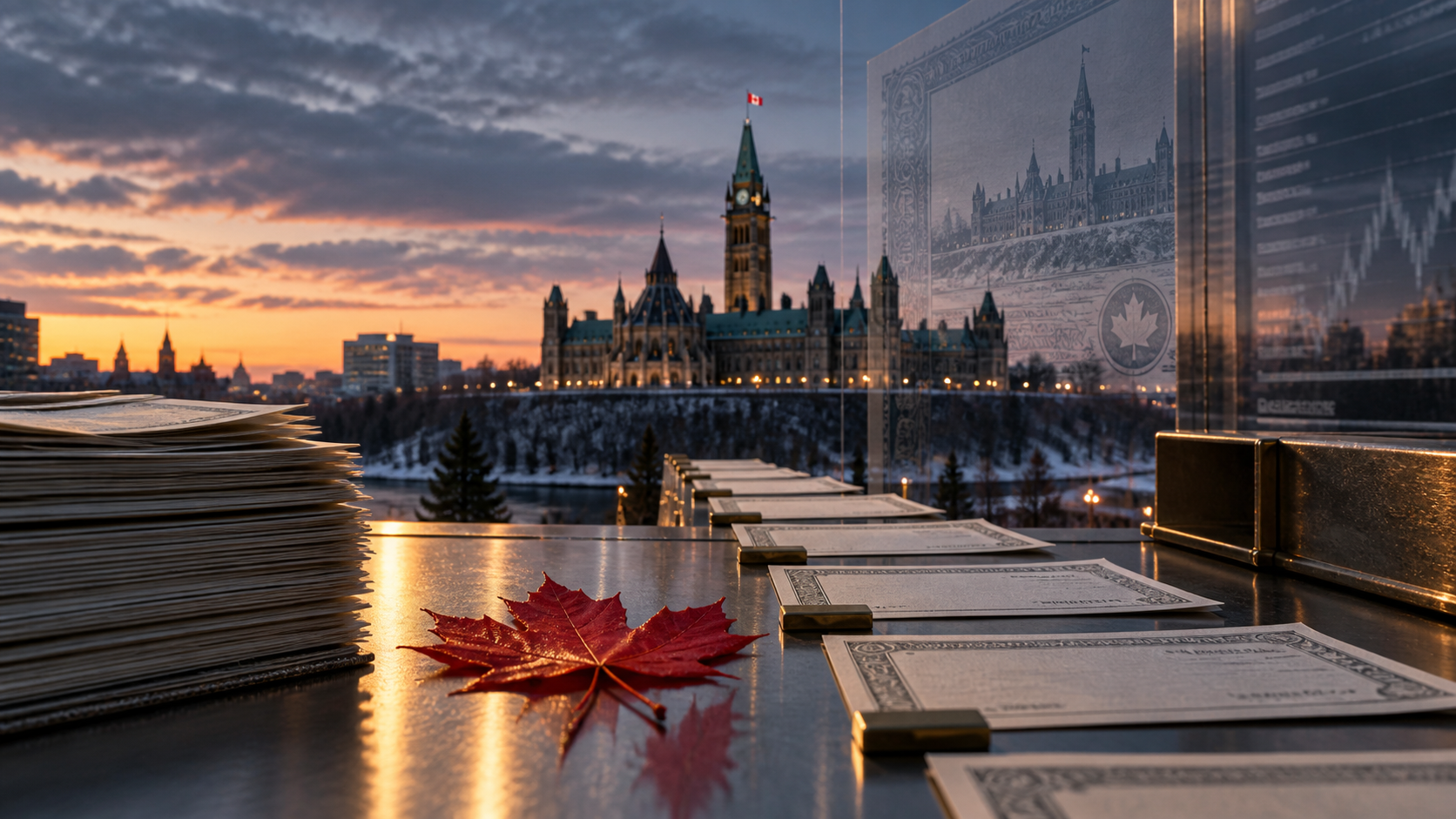
Sovereignty over energy. Sovereignty over AI. Sovereignty over trade. Sovereignty over the future.
The word arrives with steel around it: pipelines, ports, transmission corridors, a doubled electricity grid, new trade agreements, an "iron spine" running north-south through the country.
It is a strong word. It is also a dangerous one, because it gives the listener the feeling that the audit is already complete.
But if someone tells you they have taken back control of their house, you do not only inspect the locks and the driveway. You check the mortgage. You check who holds the deed. You check who gets paid before the family eats.
That is the part of the sovereignty speech Carney did not read aloud.
In fiscal 2024-25, Ottawa paid $53.4 billion in public debt charges. That was up almost $6 billion in twelve months. Federal debt stood at $1.266 trillion. Budget 2025 projects public debt charges rising to $76.1 billion by 2029-30.
So here is the audit question:
Can a country call itself sovereign when one dollar in ten of federal revenue already goes to interest — and that line is moving toward one dollar in eight by the end of the decade?
Carney's speech makes you picture pipelines and ports.
The federal financial report makes you picture a payment queue.
At the front of that queue are bondholders: banks, pension funds, insurers, asset managers, domestic savers, and foreign investors. Then come the programs, promises, provinces, workers, families, hospitals, children.
That is not rhetoric. That is accounting.
The word "sovereignty" was applied to energy corridors, technology, minerals, trade routes, and national ambition. It was not applied to the debt-service line, even though that is where sovereignty is measured in the coldest possible unit: who gets paid first.
This is not an argument against infrastructure.
A stronger grid matters. Ports matter. Energy capacity matters. Trade diversification matters, especially in a world where dependence on the United States is no longer a quiet assumption but an open political risk.
The problem is not what Carney included.
The problem is what the word "sovereignty" allowed him to exclude.
Canada can build a pipeline and still be financially constrained. Canada can sign twenty trade agreements and still have its budget disciplined by the bond market. Canada can announce an industrial strategy and still accept, as untouchable, the policy regime that sends tens of billions of dollars through interest payments every year.
That is the hidden frame: sovereignty is treated as a question of physical infrastructure, but not monetary architecture.
And that omission matters more because of who is speaking.
Before becoming Prime Minister, Mark Carney was Governor of the Bank of Canada. Before that, he spent thirteen years at Goldman Sachs. Then he became Governor of the Bank of England. His authority comes from the very world this question points toward: central banking, market discipline, bond credibility, inflation targeting, institutional trust.
That resume is not a conspiracy. It is the point.
A career central banker is professionally formed inside the post-1970s consensus: government borrowing should face market rates; central banks should fight inflation; public financing through the central bank should be treated as dangerous, unserious, or inflationary. Whether one agrees with that framework or not, it is the framework Carney spent his life enforcing.
So when the sovereignty speech reaches energy, AI, trade, and infrastructure, but never reaches the Bank of Canada, that silence is not random. It is structural.
The strongest word in the speech stops at the door of the institution that defines the price of public money.
Canada did not arrive here because a foreign committee flipped a switch in 1974. That folk version of the story is too easy, and it gets important facts wrong. Canada joined the Bank for International Settlements in 1970, not 1974, and that membership did not itself rewrite federal financing.
The real story is less cinematic and harder to pin on anyone.
For much of the postwar period, the Bank of Canada helped keep public borrowing costs low and held a meaningful share of federal debt. Because the Bank returns its profits to the Receiver General, interest on debt held by the Bank largely moved in a loop: Treasury to Bank, Bank back to Treasury, minus operating costs.
That public-finance architecture helped build real things: highways, hospitals, universities, seaways, rail capacity, national development.
Then the regime changed. In the mid-1970s, under Governor Gerald Bouey, the Bank of Canada pivoted toward monetary gradualism: controlling money-supply growth to fight inflation, rather than keeping borrowing costs low for public finance. Ottawa increasingly financed through open bond markets. The remitted loop shrank. The one-way interest channel grew.
Today that channel is a $53.4 billion annual line item.
There is a serious rebuttal, and it should be stated clearly: Canada borrows in its own currency. It cannot be forced into default the way a country borrowing in foreign currency can. Debt-service costs are not the same thing as foreign occupation, and bondholders are not a single hostile bloc.
Correct.
But that is not the claim.
The claim is simpler: every dollar paid in interest is a dollar that has first answered to the financing structure before it answers to health care, child care, defense, industry, or infrastructure. For foreign holders, the interest leaves Canada. For domestic holders, it becomes a transfer from taxpayers to savers and institutions. Either way, it is a first claim on public revenue.
Sovereignty does not vanish only at the point of default.
It thins out whenever the first claim on national income belongs somewhere else.
That is why "Maîtres chez nous" matters. The phrase was not originally a vibe. In Quebec, it belonged to the politics of ownership, electricity, and control over the revenue stream itself. Borrowing that phrase while skipping the public-money question is not just incomplete. It drains the slogan of its original weight.
Nobody needs to conspire for this arrangement to hold. It holds because respectable politics does not put it on the table. It holds because "sovereignty" can be spoken loudly over pipelines while remaining quiet over monetary policy. It holds because the people and institutions that benefit from the existing architecture do not need to win a public argument if the argument is never allowed to begin.
This is the Audit of Words.
When a leader says "sovereignty," ask where the word is allowed to travel.
If it reaches oil, minerals, AI, ports, and trade, but cannot reach debt service, then the word is not false exactly. It is partial. It is doing political work. It is showing you the visible machinery of national control while hiding the ledger that controls the machinery.
"Canada Strong" is not wrong to ask whether Canada can control its energy, infrastructure, and trade routes.
It is wrong to call that the whole sovereignty question.
The whole question is harsher:
Who does Canada's money answer to first?
Next time a politician says sovereignty, ask three questions:
Which asset? Which ledger? Who gets paid first?
Then check the debt-service ratio after every budget. If that number rises, sovereignty is being spoken faster than it is being built.
Until that line is read aloud, every sovereignty speech is unfinished.
Sources: Annual Financial Report of the Government of Canada 2024-25, Budget 2025 Annex 1. Speech source: "Forward Guidance: A Stronger Canada," PM Mark Carney, Sep 8, 2026 — https://www.youtube.com/watch?v=eYAwioM3RQI